Blog
Can Rustproofing Void Your New-Vehicle Warranty?

One of the questions we hear all the time is:
“If I have my new truck rustproofed, can the dealer void my warranty?”
The short answer is no, not simply because you had an aftermarket rustproofing product applied.
But there is an important second half to that answer that often gets left out.
If an aftermarket product or the way it was applied actually causes damage to a vehicle component, the manufacturer may deny warranty coverage for that specific damage.
That’s where the difference between having rustproofing and having rustproofing applied correctly becomes pretty important.
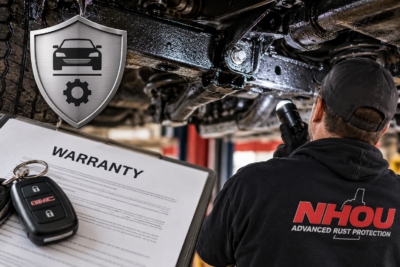
Protect Your Vehicle. Protect Your Warranty. Know the Difference.
What federal warranty law actually says
The federal Magnuson-Moss Warranty Act prevents manufacturers from simply requiring consumers to use only their branded parts or authorized service providers in order to keep a warranty in effect, with limited exceptions.
The FTC puts it pretty plainly: using an aftermarket part does not, by itself, void your warranty. If a manufacturer wants to deny coverage because of an aftermarket part or service, it must be able to show that the aftermarket product or service caused the damage involved in that claim.
So if you’ve had your frame rustproofed and your radio quits working six months later, the presence of undercoating isn’t a legitimate reason to deny an unrelated radio claim.
But that doesn’t mean aftermarket products get a free pass.
The same federal rule specifically allows a manufacturer to exclude damage when it can demonstrate that an unauthorized product or service actually caused the failure.
That’s the part vehicle owners—and applicators—need to understand.
Your warranty and damage caused by the application are two different things
GM’s own warranty information is a good example.
GMC says that a warranty could be affected when a covered system or part is damaged by an alteration, chemical treatment or aftermarket product. GM also specifically states that repairs needed because of damage caused by after-manufacture rustproofing applications are not covered by its New Vehicle Limited Warranty.
That does not mean GM says every vehicle with aftermarket rustproofing has no warranty.
It means something much more reasonable:
If the rustproofing causes the damage, GM doesn’t have to pay for that damage.
And frankly, that makes sense.
If an applicator causes the problem, that shouldn’t become the manufacturer’s problem.
This is where professional application matters
Rustproofing a modern vehicle isn’t simply a matter of putting a spray gun underneath it and coating everything you see.
There are components that should be coated.
There are components that should not.
And there are some areas where the answer depends on the exact vehicle.
A perfect real-world example comes from General Motors.
GM issued a technical service bulletin covering certain 2019-2021 Chevrolet Silverado 1500 and GMC Sierra 1500 trucks. Those trucks use specific leaf-spring tip inserts that GM says are designed to operate without lubricant. The bulletin specifically says lubricants should not be used on those inserts, and warns that grease, undercoating or other material in the leaf-spring interface can create noise as the springs move.
That’s useful information.
It doesn’t mean “don’t rustproof GM trucks.”
It means know the vehicle you’re rustproofing.
Ford provides another good example. Its 2025 Body Builders Layout Book actually identifies undercoating “keep out” areas and says undercoating should not be applied to the fuel tank, fuel-fill hose or fuel-fill vent hoses, in part because of heat buildup and possible material-compatibility concerns. Ford also specifies clearance from exhaust components.
Those aren’t arguments against corrosion protection.
They’re arguments for doing it correctly.
What about rubber?
This one gets discussed online constantly, and unfortunately the answer often gets oversimplified.
You will sometimes hear:
“Oil undercoating destroys rubber.”
That’s much too broad.
Rubber isn’t one single material.
Different elastomers have very different resistance to oils and chemicals.
Even Fluid Film, an oil-based corrosion product, says its product has no adverse effect on neoprene or Buna-N under its listed test conditions, while cautioning that non-oil-resistant rubber may swell.
That is consistent with how we approach it at NHOU.
Regular NHOU Oil Undercoating is generally compatible with the common automotive rubber components we encounter, but we avoid direct application to soft natural rubber and other materials where oil compatibility is questionable.
The correct question isn’t:
“Is undercoating safe on rubber?”
It’s:
“Is this product compatible with this particular material on this particular vehicle?”
That’s a much better question.
And some areas are simply off-limits
There are also things that should never become part of the debate.
Oil does not belong on brake friction surfaces.
If oil or another contaminant gets onto brake pads or rotors, it can affect braking performance. GM service literature itself warns against getting even specified brake lubricants onto the friction face of a brake pad.
The same common-sense principle applies to belts, tires, hot exhaust components and other areas where a coating could interfere with the component’s intended operation.
That’s not a warranty loophole.
That’s basic application competence.
So does rustproofing void the warranty?
Here is the answer we give customers:
Having your vehicle professionally rustproofed does not automatically void your factory warranty.
Federal warranty law generally prevents a manufacturer from denying unrelated warranty coverage merely because an aftermarket product or independent service was used.
However, if the rustproofing product—or the way it was applied—actually causes damage to a component, coverage for that damage may legitimately be denied.
That’s an important distinction.
And it’s why choosing the right applicator matters just as much as choosing the right corrosion-protection product.
Documentation matters too
There is another piece of this that doesn’t get enough attention.
Document the work.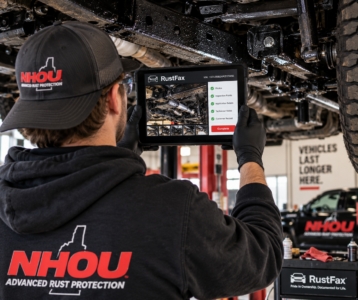
The FTC recommends keeping maintenance and repair records because they can become important when a warranty question arises.
That is one reason we’re increasingly focused on documenting corrosion protection work with service records, dates, vehicle information, application details and photographs.
If a question comes up three years later, “I think somebody sprayed something under there once” isn’t much help.
A documented record showing what was done, when it was done and what the vehicle looked like at the time is a much better position for everybody involved—the owner, the applicator and even the dealership trying to diagnose the problem.
The question we’d ask instead
So maybe the most important question isn’t:
“Will rustproofing void my warranty?”
A better question is:
“Does the person rustproofing my vehicle understand it well enough to protect it without creating another problem?”
We’ve spent about 15 years working on vehicles in the rust belt and see thousands of vehicles through our Chichester shop.
One of the biggest things that experience teaches you is that there is no substitute for knowing where the product belongs—and just as importantly, where it doesn’t.
Protect the vehicle.
Follow the manufacturer’s vehicle-specific guidance where it applies.
Document the work.
And if something shouldn’t be sprayed, don’t spray it.
That’s how corrosion protection and a factory warranty can coexist.
Frequently asked questions.
Does undercoating void a new car warranty?
No. Having an aftermarket rustproofing product applied does not automatically void the entire factory warranty. However, if the product or its application causes damage to a particular component, the manufacturer may deny coverage for that specific damage.
Can a dealer refuse warranty work because my truck is undercoated?
A dealer cannot simply deny an unrelated warranty claim because undercoating is present. A claim involving damage allegedly caused by the coating may be treated differently.
Can I undercoat a brand-new vehicle?
Yes, but the vehicle, product and application method matter. Manufacturer-specific instructions and areas that should not be coated should be identified before application.
Should an undercoating shop check for TSBs before working on my vehicle?
We believe vehicle-specific manufacturer guidance and known issues relevant to the service should be reviewed when appropriate before application.
Want to take the next step?
Find an applicator using RustFax® / My Steward Registry™
Find a participating applicator near you and start building a documented history for your vehicle.
Find an Applicator → https://nhoilundercoating.com/store-locator/
Want to learn more?
See how RustFax® and My Steward Registry™ help preserve your vehicle’s service, protection, condition, photos, and stewardship history over time.
Learn About RustFax® → |https://www.mystewardregistry.com/welcome
Explore My Steward Registry™ →https://www.mystewardregistry.com/vin-lookup
Sources & Further Reading
- Federal Trade Commission (FTC) — Auto Warranties and Auto Service Contracts
https://consumer.ftc.gov/articles/auto-warranties-and-auto-service-contracts - Cornell Legal Information Institute — 16 CFR § 700.10 — Prohibited Tying
https://www.law.cornell.edu/cfr/text/16/700.10 - GMC — Warranty Protection & New Vehicle Limited Warranty Information
https://www.gmc.com/warranty-protection - National Highway Traffic Safety Administration (NHTSA) — GM Technical Service Bulletin: Rear Leaf Spring Noise / Lubrication Guidance
https://static.nhtsa.gov/odi/tsbs/2021/MC-10199240-9999.pdf - National Highway Traffic Safety Administration (NHTSA) — Vehicle Recall Lookup
https://www.nhtsa.gov/recalls - Fluid Film — Automotive Product Information & Material Compatibility
https://www.fluid-film.com/automotive-applications/
Disclaimer: This article is provided for general informational purposes and is not legal advice. Vehicle warranty terms and manufacturer guidance vary by manufacturer, model and model year. For a specific warranty question or dispute, review your warranty documentation and consult the vehicle manufacturer, dealer or qualified legal counsel.